

INTERVIEW
Special Feature: Interview with the Former President

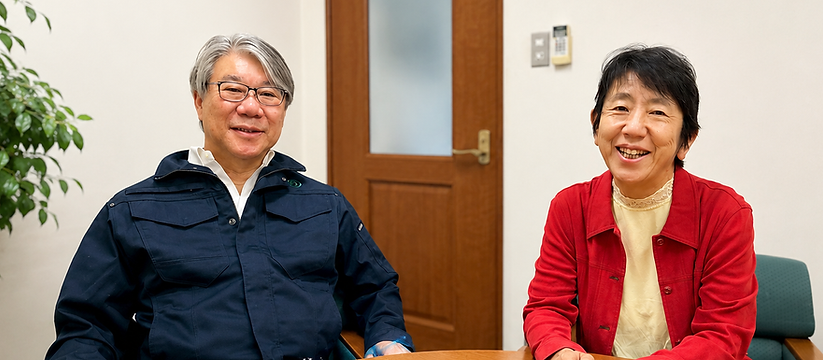
The Next 100 Years, Together with Our People — A Conversation with President & CEO Matsuyama
Interviewer: Junko Edahiro
Soichiro Matsuyama
Born in Osaka in 1955. Raised under the guidance of his grandfather, Kentaro Matsuyama (Fourth President).
March 1979: Graduated from the Faculty of Economics, Keio University
April 1979: Joined the Finance Department of NEC Corporation
1990: Posted to London (5 years)
2005: Appointed CFO of an NEC subsidiary in the United States (4 years)
2012: Appointed Representative Director, Managing Executive Officer and CFO of NEC Capital Solutions Ltd.
2016: Appointed Representative Director of RISA Partners, Inc.
2023: Appointed President and CEO of Osaka Blower Mfg. Co., Ltd.
Encountering Osaka Blower
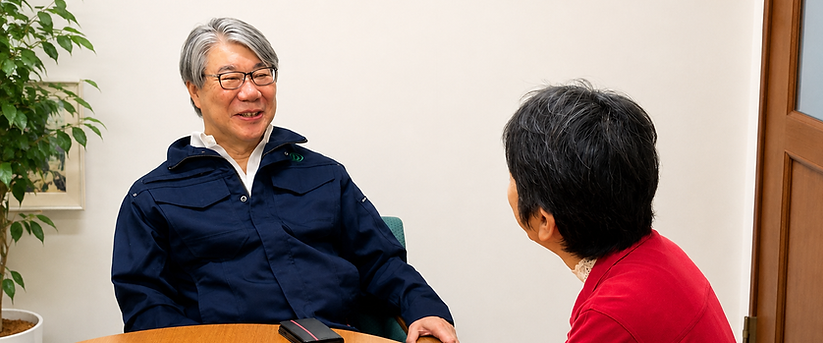
Edahiro: To begin, could you tell us about your connection to Osaka Blower?
Matsuyama: My grandfather became the company's fourth president in 1954. He had originally worked at a bank in Nagahama, Shiga Prefecture, and it seems that a connection led him to join Osaka Blower at the age of 40. When my grandfather stepped down as president in 1975 at the age of 75, my father was working at a company in Nagahama, gaining experience there while looking after our family home. At the same time, he continued the family's connection with Osaka Blower as an outside director. My father was appointed the third-generation head of that company and continued to work and gain experience there for about 70 years, until he retired at the age of 89. So, with me following my grandfather and father, three generations of our family have now been involved with this company, coming to it from outside the industry.
Edahiro: So did you have a sense from early on that you would eventually become involved with Osaka Blower yourself?
Matsuyama: By the time I was in high school, I vaguely felt that things would probably turn out that way. I had originally planned to attend my first-choice university in the Kansai region, but my grandfather told me, “If you want to learn about life, go to Tokyo,” and his words sent a shockwave through me. So I ended up going to a university in Tokyo instead, and after graduating, I had the opportunity to join NEC. I then spent about 40 years at NEC, undergoing what my grandfather called my “training in life.”
Edahiro: When did you actually begin to be involved in the company's management?
Matsuyama: From June 2018. That March, just as I had completed 40 years at NEC, the president at the time asked me to help with management, and I was given the opportunity to join as an outside director. The next president then asked me to serve as a full-time (on a remote basis) senior managing director and share in running the company.
Edahiro: So it was about three and a half years ago that you became president?
Matsuyama: January 2023. Actually, it all came about quite suddenly. The previous president fell ill and sent me a message from the hospital saying, “I don't think I'll be able to return, so I'm leaving the rest to you.”
~2018: Appointment as President~
Edahiro: When you became president, what kind of company did you feel this was?
Matsuyama: After becoming involved with the company in 2018, I came to feel that it had tremendous potential. However, I felt that the management system needed to ensure sustainability was not yet fully in place, so I have been thinking ever since about what is needed to realize the company's potential. I believed it would take at least ten years to lay the foundation for the next hundred years, and that a more sustainable approach would be to build a company where, with a focus on each employee becoming self-directed, employees themselves take ownership and can run the company together as a team.
Edahiro: Is there anything you've come to realize over these three and a half years?
Matsuyama: My biggest discovery has been how straightforward and open our employees are. I felt this was truly a great asset. If we set a clear direction and move forward, there is still a great deal of room to grow. Feeling that became a major source of motivation for me as well. I also discovered that we have technological capabilities found nowhere else. And I came to believe that this is a company that can create “environmental value.”
Toward the Next 100 Years — Technology, the Environment, and People Development

Edahiro: Could you tell us about the technological capabilities unique to Osaka Blower?
Matsuyama: There's a famous story from the 2022 soccer World Cup known as “Mitoma's one millimeter,” where a goal was decided by a margin of just one millimeter. At our company, our benchmark for quality isn't that “one millimeter,” but “0.01 millimeters.” What's more, we don't automate everything with machines and robots; a considerable part of our work relies on human hands and skills. A great deal of craftsmanship has been built up here, and techniques have been passed down from senior employees to their juniors under the philosophy that “failure is the greatest source of learning.” How to carry forward the parts that only people can do, while also drawing on the power of AI and robots, is a major challenge going forward.
Edahiro: Another keyword you mentioned was “environmental value.”
Matsuyama: This is a personal story, but my grandfather took a liking to my mother, who worked at a bank he did business with, and she married into our family in Nagahama, Shiga Prefecture, as the bride of his eldest son. When I was in elementary school, she became alarmed about the pollution of Lake Biwa by synthetic detergents containing phosphorus and took the lead in a "powdered soap movement" through the local women's association. Ours was a household deeply committed to environmental issues, with a strong sense that, as people living upstream of Lake Biwa, we must not cause problems for Kyoto and Osaka downstream. That formative experience, together with my encounter during my university years with The Limits to Growth, the 1972 book associated with the Club of Rome and MIT professor Dennis Meadows and others that sounded the alarm about global environmental destruction, meant that concern for environmental issues has stayed with me ever since. That is why I feel it is deeply meaningful that our core business itself can contribute right at the heart of environmental issues. Adding to that, life cycle assessment (LCA), which you, Ms. Edahiro, introduced to us, has given us another tool and, I feel, sharpened what we can do even further. I don't think of us as simply a "parts manufacturer"; rather, I believe we are a company that carries the value chain forward, using LCA to visualize the supply chain and create a new environmental value chain.
Edahiro: The work being done through EGR and the Second Business Division is also right at the heart of the environment, isn't it?
Matsuyama: That's right. EGR is a technology for handling exhaust gas, and the International Maritime Organization (IMO), recognizing that shipping accounts for about 90 percent of global logistics, is tightening regulations not only on CO₂ but also on NOₓ. The stricter Tier III NOₓ regulations are scheduled to be introduced in 2028, so there is worldwide demand for exhaust-gas solutions themselves. In addition, the fuel cells handled by our Second Business Division are used in trucks and buses, as well as in stationary applications for convenience stores, and their potential use is also expanding in luxury cruise ships in Europe and large-scale projects in China. I feel this is an area that connects directly to our company's vision for the next 100 years—one that looks toward decarbonization, and "beyond decarbonization."
Edahiro: The idea of moving from a "parts manufacturer" to a "company that carries the value chain forward" is also striking.
Matsuyama: What we want to do is look at value across the "entire supply chain." Being able to carry out LCA in partnership with ABB became a major success story for us. It made me feel that small and medium-sized enterprises have the potential to create new business models. We want to visualize LCA across the supply chain and translate that into a new form of value—"environmental value." To do this, I think it's important to team up with engine manufacturers, who are among our key customers, and use LCA to visualize and make the case that their engines can contribute to the environment. By serving as a hub and taking the lead in this visualization, we can see where in the design environmental impact can be reduced. A blower draws in, pushes out, and circulates air. It may be small, but it has great power. If a ship's auxiliary blower stops working, the ship could sink. I believe that "design improvements that enhance environmental value" through these kinds of technological improvements, together with "the creation of an environmental value chain through visualization of the supply chain," will come to represent the true appeal of this company.

Before We Build Products, We Build People
Edahiro: Finally, I'd like to ask about the people side of the company. How do you plan to nurture and value the strengths of employees who have both openness and craftsmanship?
Matsuyama: The shared keyword between the previous president—who had risen through the ranks on the shop floor and served as factory manager—and myself was "before we build products, we build people." The two of us shared the belief that we should first develop our people. I believe that for a company to remain sustainable going forward, it needs people who can work and act in a self-directed way, so we even flipped our organizational chart into an inverted triangle, with employees at the top and management at the bottom, in a supporting role. We also revised our evaluation system, renamed it the "Growth Challenge Program" starting in fiscal 2026, and created a mechanism to support "people development." I believe that, especially for small and medium-sized enterprises going forward, this is no longer an era in which a charismatic president leads the way. What matters is working as a team, where the power of each individual comes together, with everyone contributing through what they enjoy and what they are good at—a so-called "group of self-directed professionals."
Edahiro: You've gone so far as to consider the question, "Who does the company belong to?"
Matsuyama: That's right. I believe a company is an institution that exists for the benefit of society. Especially going forward, I think companies that can contribute to addressing environmental issues will gain the support of those around them and resonate with people. I believe it is precisely such companies that will be sustainable. That is also why our employees currently hold roughly 40 percent of the company's shares, so that they can take ownership of running it. Eventually, I hope employees will continue to pass on the baton through the "endorsement of share certificates," seeing it as "their own company" and sustaining it over time. I see this as a mechanism for passing on this "great baton of aspiration" toward the next hundred years.
Edahiro: As president, when do you most feel, "I'm glad I'm doing this"?
Matsuyama: It's definitely seeing the changes that come with our employees' growth. Their actions and words gradually change, sometimes faster than I expect. When I see someone who previously hardly took action begin to act, I truly feel that it has all been worthwhile. Throughout my 40 years at NEC, I always exercised leadership myself, but now, instead, I have others take the lead. Although the process of watching it all take shape is challenging, it's also a lot of fun. I can't help wanting to step in and help. I really do feel that "being president is 99 percent about developing people," and I find it a truly fascinating role.
Edahiro: That's wonderful. Thank you very much.
